Alfred Binet
The man who built the first IQ test — and warned us not to trust it as a verdict.
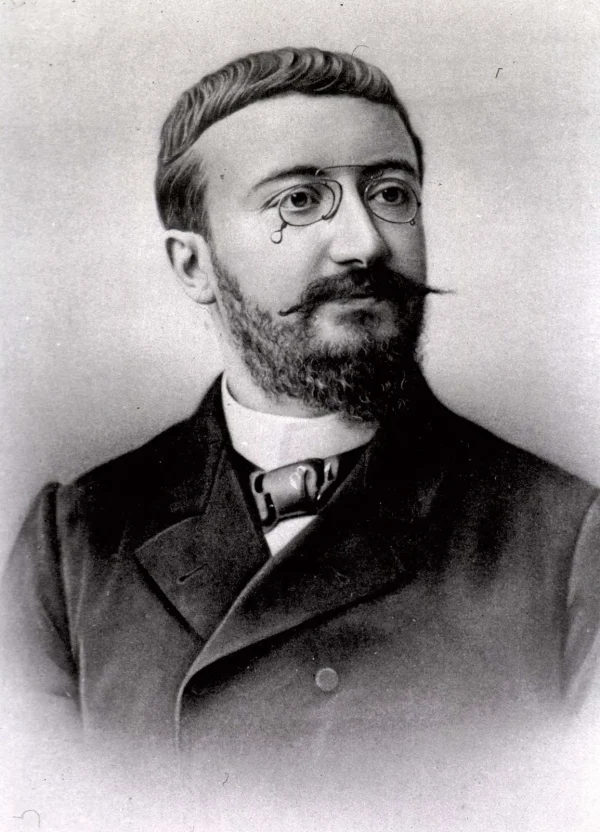
Alfred Binet was born in Nice in 1857, when Nice still belonged to the Kingdom of Sardinia. His birth certificate read Alfredo Binetti. Three years later, France annexed the city and the spelling of his name was quietly changed by the prefecture; he kept it. He was raised in Paris by his mother after his parents separated, took a law degree in 1878, did not practise, and spent the next several years teaching himself psychology in the reading rooms of the Bibliothèque Nationale.
He never held a university chair. He published more than two hundred books, articles, and reviews anyway.
His early career was a near-disaster. He worked under Jean-Martin Charcot at the Salpêtrière clinic on the psychology of hypnosis, and was forced into a public retraction when a Belgian researcher demonstrated that Binet’s experimental subjects were responding not to hypnotism but to the unconscious cues of the experimenters. He left the Salpêtrière in 1890 and never spoke of it again. The episode taught him a kind of intellectual humility that ran through everything he did afterwards.
He had two daughters. Marguerite, born in 1885, was — in his description — an objectivist: careful, deliberate, the kind of child who turns a problem over before answering. Alice, born in 1887, was a subjectivist: quick, intuitive, less interested in being right than in being interested. He watched them and concluded what every parent of two children eventually concludes: there is more than one kind of intelligent. The conclusion shaped the rest of his life’s work.
In 1891 he joined the Sorbonne’s Laboratory of Experimental Psychology. By 1894 he was its director. He held that post until his death.
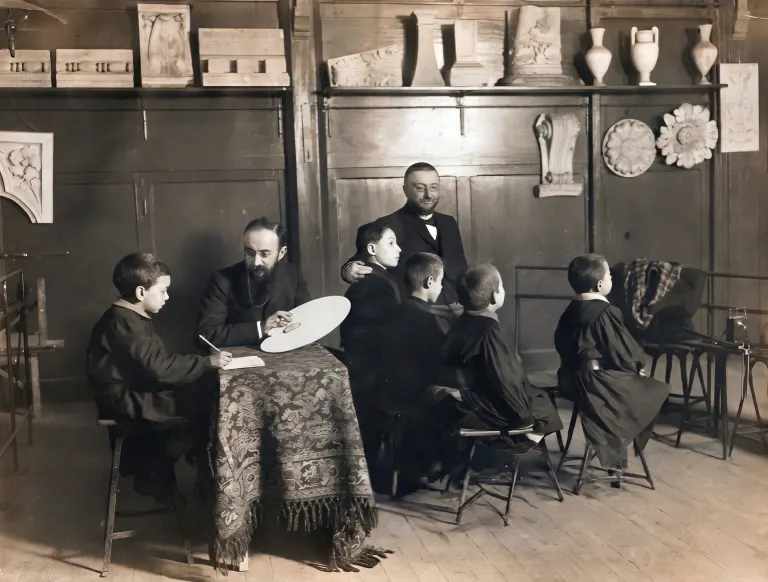
In 1904 the French Ministry of Public Instruction appointed him to a commission with a single, narrow question: how do you decide which children need extra educational help? The status quo answer — leave it to a doctor’s judgement — was producing inconsistent results and, often, unfairly placing children into asylum-attached schools. Binet’s answer was that the decision needed to be made on objective criteria so that “no child would get the label erroneously.” He partnered with a young psychiatrist named Théodore Simon, who had access to a study population of children with intellectual disabilities, and together in 1905 they published the first working version of what is now called the Binet–Simon Scale.
The scale was thirty tasks, ordered from easiest to hardest. The easiest asked a child to follow a moving light with their eyes. The hardest asked the child to figure out, from a clue, what was happening at the neighbour’s house: “He has been receiving in turn a doctor, a lawyer, and a priest. What is taking place?”
The scale produced a mental age — the age-band whose tasks the child could complete. Binet was the first to use the concept in this practical form. He standardised the original scale on only ninety-five children. He said so openly. He warned, repeatedly, that the resulting scores “do not merit absolute confidence” and could vary noticeably between sittings. The scale was a tool for educational triage, not a verdict on a child’s worth. He was insistent on this point.
He revised the scale in 1908 and again in 1911 — the last revision shipped in the year of his death. He was fifty-four. He died in Paris on the eighteenth of October, 1911.
What he believed
The single conviction at the centre of his work: intelligence is not a fixed quantity. It is a collection of judgements developed in contact with the world, and it can be raised through proper education. He coined a phrase for the opposing view: brutal pessimism. He used it in 1909, in a book called Modern Ideas About Children, in the most quoted passage he ever wrote:
“Some recent philosophers seem to have given their moral approval to these deplorable verdicts that affirm that the intelligence of an individual is a fixed quantity, a quantity that cannot be augmented. We must protest and react against this brutal pessimism; we will try to demonstrate that it is founded on nothing.”— Alfred Binet, Modern Ideas About Children, 1909
He designed exercises — he called them mental orthopedics — for attention-training, working with children that other psychiatrists had written off. Many of them improved. He took it as evidence.
He also believed:
- Intelligence is plural. “Comprehension, inventiveness, direction, and criticism: intelligence is contained in these four words” (Modern Ideas About Children, 1909).
- The faculty being measured was best called judgement — “good sense, practical sense, initiative, the faculty of adapting oneself to circumstances.”
- Tests are tools for help. They are not labels. The whole point of the 1904 commission was that the alternative — psychiatric judgement alone — sent children to asylums.
What happened to his work
In the United States, Henry Goddard translated the Binet–Simon Scale and distributed twenty-two thousand copies before 1915. He used it to argue for the eugenic restriction of immigration and the forced sterilisation of people he classified as “feeble-minded.” Lewis Terman at Stanford published a revised American version in 1916 and called it the Stanford–Binet. He imported William Stern’s Intelligenz-Quotient — the ratio of mental age to chronological age, multiplied by 100 — and the IQ score was born. Binet had been dead for five years.
It is the great irony of his career that the test he built to prevent the labelling of children became, in another country, the principal instrument used to label them. The eugenic uses of the early twentieth century are well documented; Binet would have recognised every one of them as the brutal pessimism he spent his life arguing against.
The Stanford–Binet has been revised four more times since Terman: 1937, 1960, 1986, and 2003 (the current Fifth Edition, by Gale Roid). Each revision has moved further from the eugenic context of the 1916 American release. The factor structure used today — five factors — is closer in spirit to Binet’s own pluralist view of intelligence than the single-number IQ that Terman built on top of his work.
Théodore Simon
A note on his collaborator. The Stanford revisions had the effect, almost certainly unintended, of erasing Théodore Simon from the public record. The American name of the test became “the Stanford-Binet”; Simon’s name fell off the cover. He outlived Binet by half a century — he died in 1961 — and continued the work in France throughout. The original society Binet had helped found was renamed in 1917 La Société Alfred Binet; in 1968 they renamed it again, La Société Binet–Simon, to put Simon’s name back where it belonged. We use Simon’s name freely on this site, by preference. Binet would have wanted it.
Further reading
- Modern Ideas About Children (Binet, 1909) — out of print in English; available in selected libraries.
- The Mind and the Brain (Binet, 1907) — translated by Legge, available on Project Gutenberg.
- Two Persistent Myths About Binet (Wassmann, Collabra: Psychology, 2024) — the most careful modern correction of misconceptions about him.
- Wikipedia and Wikiquote both have well-cited entries.

 Secure checkout


