Sample report — fictional example. The name and scores below are invented to show the report format; they are not a real person’s result. After you complete your assessment, access your report in your account.
Stanford Binet SB5
Report
October 10, 2026
IQ Test
Stanford Binet ReportFor:
October 10, 2026
Hamza Abdeen
Result
The Fifth Edition of the Stanford-Binet Scale (SB5) was applied to assess general cognitive abilities and overall IQ. The test contains five sub-tests within the field, and the tests measure several cognitive functions.
Name
Hamza Abdeen
Test Reference
587
Age
26 Years 10 Months 10 Days
Report date
October 10, 2026
Your overall IQ level
Above Average128
40557085100115130145160
Innate
Memory
Knowledge
Visual
Logical
Brain Age
125
130
120
140
115
26.8 - 27.4
less than 70Delayed
70 - 84below average
85 -114Average
115 - 129Above Average
130 - 144Talented
Above 144Genius
SubtestsDerived from the stanford-binet scale
Innate IntelligenceA genetic intelligence with which a person is born apart from experiences and acquired knowledge.
Working MemoryIt is the memory that processes information in short-term memory to understand and connect it using information stored in long-term memory.
KnowledgeThe accumulative stored information, experiences and skills acquired at home school or work.
Visual-Spatial ProcessingIt assesses the ability to mentally visualize and manipulate objects in space. It evaluates how effectively one can perceive and interpret spatial relationships.
Logical-Mathematical IntelligenceIt is a key aspect of cognitive ability, involves the capacity to analyze problems logically, carry out mathematical operations, and investigate issues scientifically.
Brain AgeStanford-Binet iQ test measures how well your brain functions relative to your age. It evaluates mental agility to determine whether your brain is aging faster, slower, or in alignment with your chronological age.
OverallDerived from the stanford-binet scale
Above Average128
40557085100115130145160
It is the score derived from all subtests and indicate the overall mental and cognitive ability, which is commonly known as IQ.
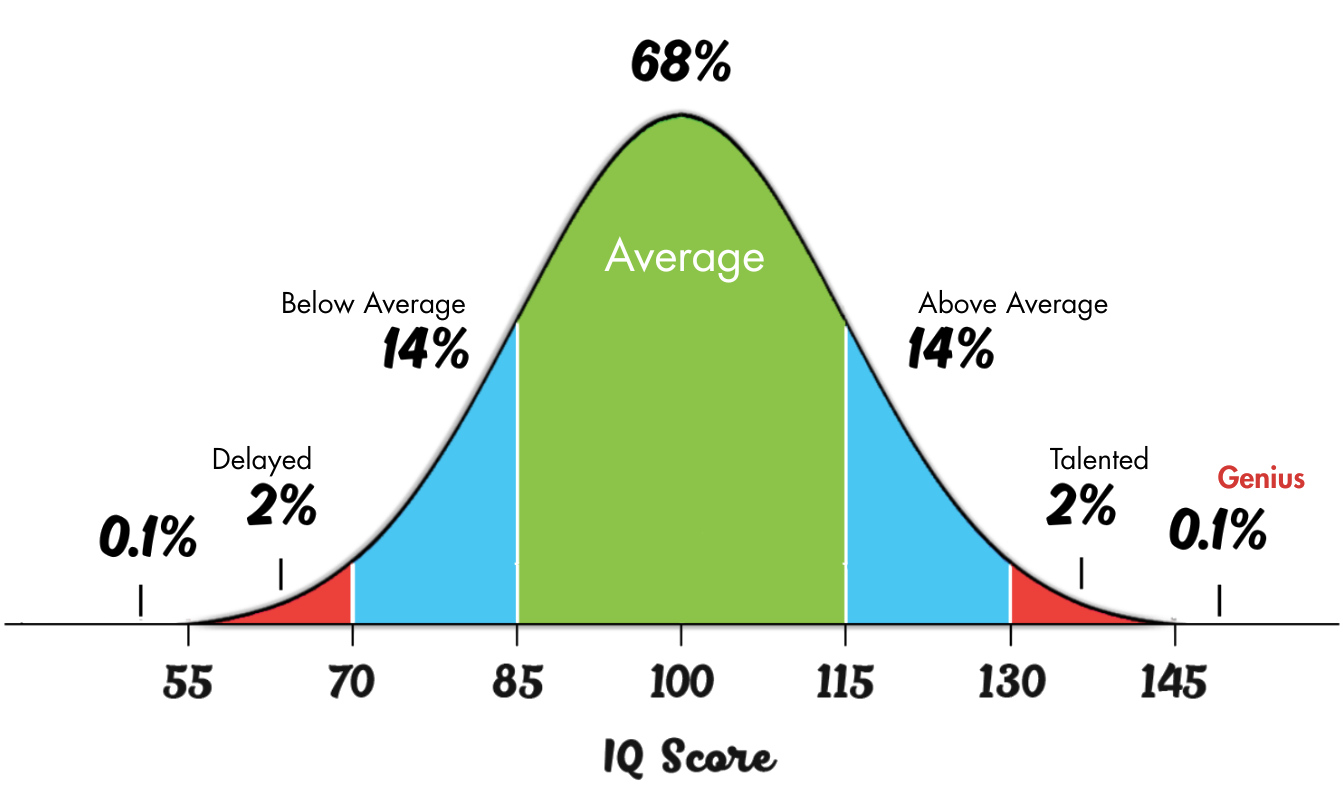
IQ scores are classified by age. When IQ tests were developed, the average score was set at 100 points with a standard deviation of 15 degrees,
i.e., a score of 85 and above achieved by a person
Means such a person is among the average category, as two thirds of populations have a range of 85 to 115 points. However, individuals with a score over 115 is above average.
Geniuses get a score over 145 points, IQ is used for education level test and measurement of talent and mental retardation of school pupils.
In addition, IQ is used in admission tests made by a big number of universities worldwide and in assessing job applicants. IQ is studied in research context as indicators of job performance and financial income. In general, psychologists consider IQ tests to have a high statistical credibility.
Normal Distribution
This is the most important distribution in the field of statistics. The Gaussian (normal) model has roots in the work of Gauss and Laplace in the early 19th century.
The normal distribution curve applies to all humans in most cases and traits, including intelligence quotient (IQ) and mental abilities. As you can see, 68% of people fall within the average category, while the percentage decreases as we move to the right or left within the curve. Geniuses make up only 0.15% of the population.
Innate Intelligence
40557085100115130145160
Above Average125
Innate Intelligenceis a genetic intelligence with which a person is born apart from experiences and acquired knowledge.The importance of this type of intelligence lies in our ability to solve problems in various situations, particularly when we face a problem on which we have no information or experiences.Innate Intelligenceenables us to find solutions for new problems and learn new patterns and sciences. Therefore, Innate Intelligenceis an individual’s ability to think logically and solve problems regardless of previously acquired knowledge.Innate Intelligenceis particularly important for children during the learning stage, as they go through new experiences and acquire different skills on a daily basis. At childhood age, the brain is at its highest activity level, with over 100 billion nerve cells ready to respond and learn. Parents should seek to ensure that their children gain as much knowledge as possible at an early age.
How to develop?
It is the genetic intelligence gained from parents apart from environment; therefore, it is not easy to be developed but the individual one can show his best through a healthy lifestyle, which can be summarized in healthy food, having enough sleep and workout.
Working Memory
40557085100115130145160
Talented130
Working memory refers to the cognitive process that facilitates the understanding and connection of information from short-term to long-term memory.This process enables individuals to perform complex mental tasks by bridging the two memory systems. Working memory is critical in tasks that require individuals to temporarily store and manipulate information such as phone numbers, grocery lists, or instructions. While this type of memory is intended for immediate use, it is crucial for many daily tasks.Working memory plays a crucial role in understanding and comprehending complex information. It enables individuals to store and connect information, allowing them to derive meaning and draw conclusions. Whether studying, watching a movie, or reading a book, working memory is essential for individuals to understand and connect the different elements of the material.
How to develop?
1. Lorem ipsum games exercit.2. Dolor focus exercitii lorem.3. Libros legere et narrare.4. Pictura.
Knowledge
40557085100115130145160
Above Average120
Knowledge can be defined as accumulative stored general information, experiences, and skills acquired at home, school, or work, gained through learning and experience, and stored in the long-term memory throughout an individual’s life.Long-term memory can store billions and billions of information and experiences, estimated by some sciences to be 2.5 petabytes. To illustrate how big this number is, a petabyte is equivalent to one million gigabytes.In other words, a human brain can store information more than what five million computers combined can do.People are distinguished by their cognitive abilities based on two key points: (i) the quality and importance of acquired information, and (ii) the brain’s ability to retrieve such information from long-term memory. Therefore, parents should ensure that their children receive useful information during their childhood, particularly the information received by pupils from school. It is also important for children to stay away from habits that can affect the quality of memory work, such as spending too much time using a smartphone and failing to have enough sleep.
How to develop?
1. Lorem ipsum sit amet cum sociis et senes familiae (for kids Only).2. Vestibulum programas culturae et doctrinae spectare.3. Legere et tractare libros fabulasque cum aliis.4. Facere simplices investigationes scientificas et experimenta.5. Subscriptio in variis cursibus atque in itinera doctrina ire.6. Exploratio et explanatio differentiarum inter similia et varia (for kids Only).
Visual-Spatial Processing
40557085100115130145160
Talented140
Visuo-spatial processing is a crucial ability that many may be unaware of, but its impact on individuals' lives cannot be neglected.The ability of a surgeon to work on human bodies, an artist to create masterpieces, or a sculptor to craft intricate details is largely due to their heightened visuo-spatial processing skills.This ability allows individuals to understand their surroundings and perceive location and dimension. From childhood play to finding one's way back home, this skill plays a vital role in daily life.Individuals with strong visual-spatial processing skills can easily comprehend maps and precisely imagine the world, modifying their surroundings to match their perceptions.They can also recreate vivid visual experiences with remarkable accuracy, easily recalling images, faces, and minute details. Their capacity to imagine things from diverse perspectives is a hallmark of their exceptional visuo-spatial intelligence.
How to develop?
1. Utendo verbis spatii in cotidianis actibus, ut sub, super, meridies, dextra… etc.2. Discere imaginationem et directiones per ludos (for kids Only) .3. Consilium capere, designare et aedificare ludos ut puzzles, structurae et labyrinthi.4. Pictura, sculptura, photographia, designatio graphica et musicae.5. Discere atque investigare tabulas.6. Cursus Arithmeticae Mentis, utiles ad artes mathematicae et alias plures evolvendas.
Logical-Mathematical Intelligence
40557085100115130145160
Above Average115
Logical-Mathematical intelligence refers to the ability to solve numerical problems in real-world situations, as well as the capacity to analyze situations logically, identify solutions, engage in scientific research, and solve logical-mathematical problems with ease. This type of intelligence has had a significant impact on the world, contributing to the considerable advancements in recent times.It enhances our ability to perceive and connect different elements in a broader perspective and nurtures our analytical skills to develop efficient solutions.It should be noted, however, that while the evaluation of someone's IQ is commonly linked to their mathematical abilities and academic achievements, logical-mathematical intelligence is just one of many abilities that contribute to one's overall intelligence.It is entirely possible for someone to excel in other fields, such as foreign languages, arts, or sports, while struggling with simple mathematical problems.Famous scientists such as Isaac Newton and Albert Einstein, who are widely recognized for their contributions to scientific discovery and the advancement of humanity, are known for their exceptional logical-mathematical intelligence. However, it is interesting to note that two U.S. presidents received low scores in this area.Therefore, it is crucial to identify and support our children's individual abilities to guide them towards success in areas where they can be creative. While logical-mathematical intelligence is essential, it is equally important to recognize and foster their other strengths to enable them to reach their full potential.
How to develop?
1. Solvendum aenigmata logica-mathematica.2. Tractatio numerorum utendo pecunia in vita et ludis (for kids Only).3. Facienda experimenta scientifica quae utuntur numeris et logica analysi.4. Cursus mentales calculi, utiles ad artes mathematicae aliasque evolvendas.5. Subscriptio in cursibus programmandi quia nituntur intelligentia logico-mathematica.
Strengths and WeaknessesEach person has weaknesses and strengths related to their mental abilities, and the Stanford-Binet test can shed light on some of them through test results.
Strengths
Loca bene meminere clare solent.
Imaginantur quae cogitant et audiunt.
Saepe pingunt ut se ipsos adiuvant ad cogitandum.
Celeriter discunt artes et ludos athleticos et
Res vident ex conspectu generali.
Possunt res examinare atque concludere.
Eventus iungere atque conferre valent.
Mandata meminere solent et opus tempestive perficiunt et
Possunt multa simul agere / plura munera parva conficere.
Weaknesses
uti calculatrice post scripta methodorum problemata.
Tendit ad vitandum numeros in ullo plano extra actiones mathematicae et
Præferunt modos solvendorum problematum claros et traditos
Career and Academic AdvicesEach person has unique abilities and talents, and the Stanford-Binet test can help identify the best academic major and career path aligned with their cognitive strengths. This ensures individuals can work in roles that suit their brain's capabilities.
Best-Fit Careers Based on your cognitive abilities
Loremgraphus.
Structurae artis.
Volatus dux.
Athleta peritus.
Tela excogitator.
Corpus curatio.
Domus ornatus.
Ingeniaria civis.
Codicis artifex.
Chirurgus et
Vestis excogitor.
Academic Advice
Est relatum ad quamlibet rem tractantem processum visu-spatii.
Praesertim magni momenti est pro artibus visualibus, technologia artis et delineatione mechanica.
“ Everybody is a Genius. But If You Judge Fish by their Ability to Climb a Tree, They Will Live Their Whole Life Believing that they are failures. ”
Not an official clinical Stanford-Binet administration or a substitute for a professional evaluation.
 Stanford Binet SB5
















 United states
 United kingdom
 Secure checkout


